Belief Building December 2024

This time of the year is often associated with a review or look back at movies, music or books released during the year.

I like hearing and reading about what others have enjoyed, so this month I’ll share some of my highlights from 2024.

Perhaps a wrap-up is also timely, as I intend taking a break from writing this newsletter in 2025.  I have created 36 Belief Building newsletters over the last 3 years.  I hope you have enjoyed reading them as much as I have enjoyed putting them together.

Thanks to everyone who shared and recommended inspiring people, ideas, blogs, social media clips, newspaper articles, books or poems. Thanks for your feedback and thanks for reading.

Best wishes for 2025.
Sinead

According to Spotify Wrapped, the top 3 artists I listened to this year were Taylor Swift, Coldplay and Sia. I was a bit surprised by Sia but it seems she features on a lot of the songs that I like!

The 3 books that had the most influence on me in 2024 were:
Chris Hadfield “An Astronaut’s Guide to Life on Earth”
Marie Kondo “Spark Joy”
Oliver Burkeman “Meditations for Mortals”.

I enjoyed Chris’ book as it expanded my knowledge of space in a very easily digestible way. It was interesting to read about exercising in zero gravity and the other challenges faced by Chris and his team-mates.

Marie’s book has had a practical affect in terms of how I store my clothes.  Folding them and putting them away takes a little longer than usual but it is worth the effort.

Oliver’s book “Meditations for Mortals” has impacted me in terms of how I think about time and success.  If I had to sum up his message, I’d say; “Life is for living right now and we shouldn’t wait until we’ve cleared the decks of all the things we intend doing first so we can have the perfect run at what we think will be our perfect life. There is no perfection, what we have is just now, just this moment, in all its imperfection.”

I enjoy many different newsletters but I have picked these as my top 3: 
Oliver Burkeman The Imperfectionist
Page Grossman: do5ive
Padraig O’Morain Daily Bell 

Oliver’s newsletter is quite infrequent, perhaps one every 2 months or so but generally an interesting reflection on time and productivity. 

Page’s do5ive is usually sent fortnightly on Tuesdays and Page offers 5 different things to ponder, often on similar themes to Oliver’s newsletter or often related to the time of the year. She also usually includes The Other 5 which is a short and snappy list of what Page is reading or perhaps a link to a podcast or recipe.

Padraig’s Daily Bell email arrives in my inbox every day. It is usually just a paragraph long but always a nice reminder of mindfulness or taking a breath or pressing pause on unhelpful thinking.


I didn’t include movies or TV shows in the lists above as it is difficult to think of 3 that left a lasting impression on me in 2024. 

So whilst it’s not from 2024, I’m going to mention just one TV show, Ted Lasso. Given this newsletter is called Belief Building, I particularly enjoyed the message in the show, epitomised by the poster in the dressing room that said “Believe”.

I’m not giving anything away when I mention that there’s a part in Ted Lasso that includes Rick Astley’s song “Never Gonna Give You Up”.  But mentioning this allows me a segue into a side story regarding Rick Astley which is from a Financial Times article of 28 September 2024 written by Emma Jacobs “What Rick Astley can teach us about giving up”

The article begins with the line “Rick Astley is famous for two things. His 1987 hit, “Never Gonna Give You Up”. And giving up.” It goes onto elaborate that Rick feels lucky to have had the career trajectory that allowed him return to music 20 years after taking a break. The article ends with Rick’s words where he advises that he would recommend a year off rather than quitting completely.  I read the article in September around the time that I was thinking about taking a break from writing this newsletter. If I met Rick, I think I would say that I might take a year off or I might take less or I might take more.  But I will keep reading Oliver’s advice to live in the moment and enjoy what I have without trying to be perfect about anything.


I think perfectionism is based on the obsessive belief that if you run carefully enough, hitting each stepping stone just right, you won’t have to die. The truth is that you will die anyway and that alot of people who aren’t even looking at their feet are going to do a whole lot better than you and have a lot more fun while they’re doing it.” Anne Lamott

“It may not work out how you think it will or how you hope it does. But believe me, it will all work out.” Ted Lasso

Things don’t have to be perfect to be a success.” Chris McCausland, Comedian and Winner of Strictly Come Dancing 2024

Time Capsule

On this day, 3rd April 2022, those of us living in Ireland get the chance to complete our Census form. For the first time, we can include comments in a time capsule section which will be opened in 100 years.

Coincidentally, I have my own time capsule today. Twenty years ago, long before I had a website or even knew what a blog was, I had something I wanted to get off my chest.

I was working as a temp in Sydney, Australia and I was not impressed with the level of respect shown in the workplace. Luckily for me, the Sydney Morning Herald newspaper had a column called The Heckler, a place where one could apply their wit to anything that made their blood boil.

So with a sprinkling of humour, I got my chance to have my say on 3rd April 2002.

I hope you enjoy reading my publishing debut and I hope things have changed for temporary office workers!

From Sydney Morning Herald 3rd April 2002

Feature Image Credit: Matthew Ball via unsplash.com

A Happy Meal

Have you heard the advice: “When life gives you lemons, make lemonade“?

It’s advice to seek out the positive in a negative circumstance.

Throughout the pandemic, we have had lots of encouraging examples of this in practice, situations where individuals and businesses have used innovation to turn challenging events into opportunities.

Here’s a smaller scale example but it’s close to my heart.

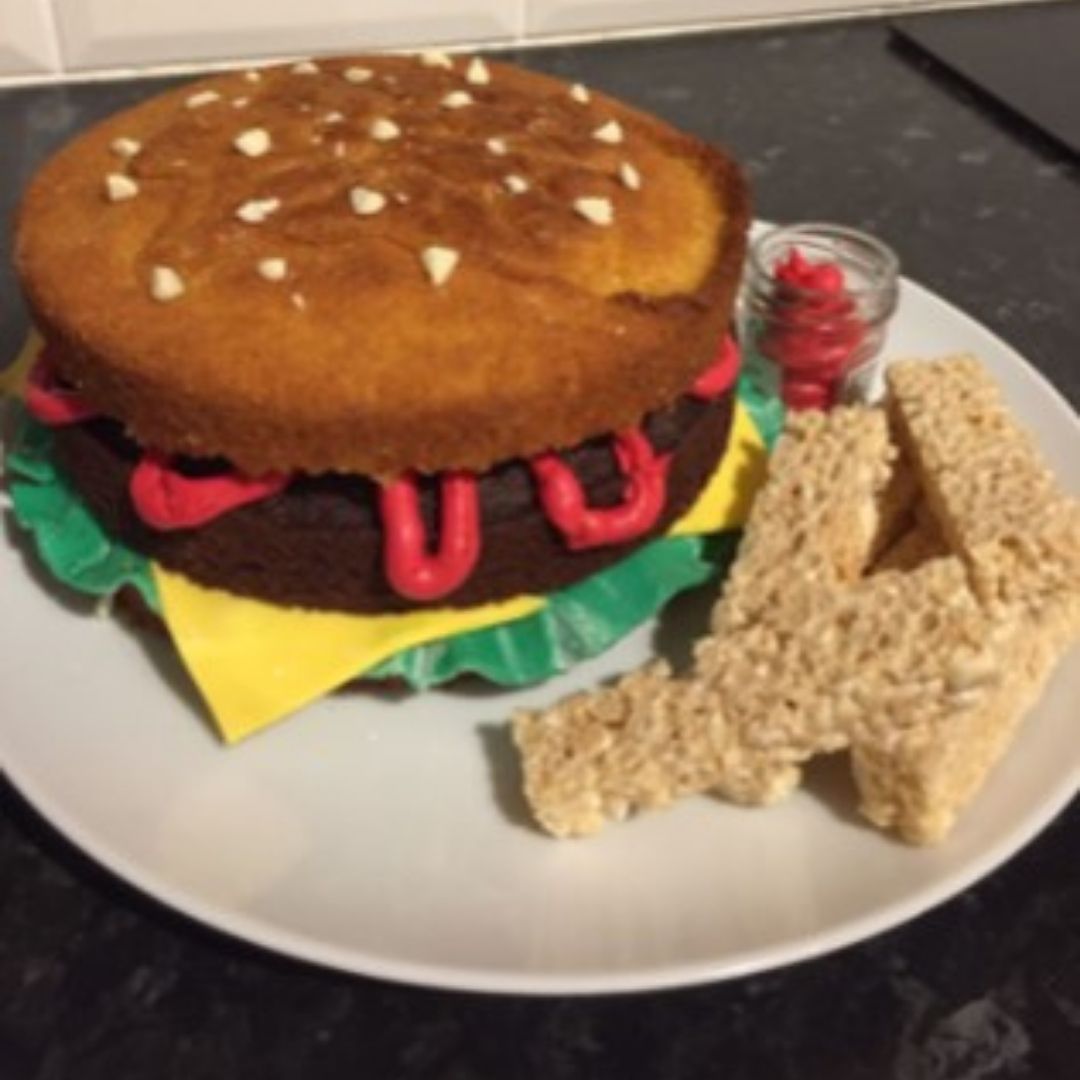
My young nephew celebrated his birthday recently. His wish for his birthday was that he and his family would go to ‘Old McDonalds‘. He likes to eat burgers and was curious as to where they keep all the noisy farm animals.

Unfortunately before the birthday, Covid paid a visit so going anywhere to eat burgers or suss out farm animals was off limits.

My nephew was disappointed but his innovative and talented mum was at least able to deliver on the burger front.  What you see in the photo is the birthday cake!

Burger for main course and dessert anyone?

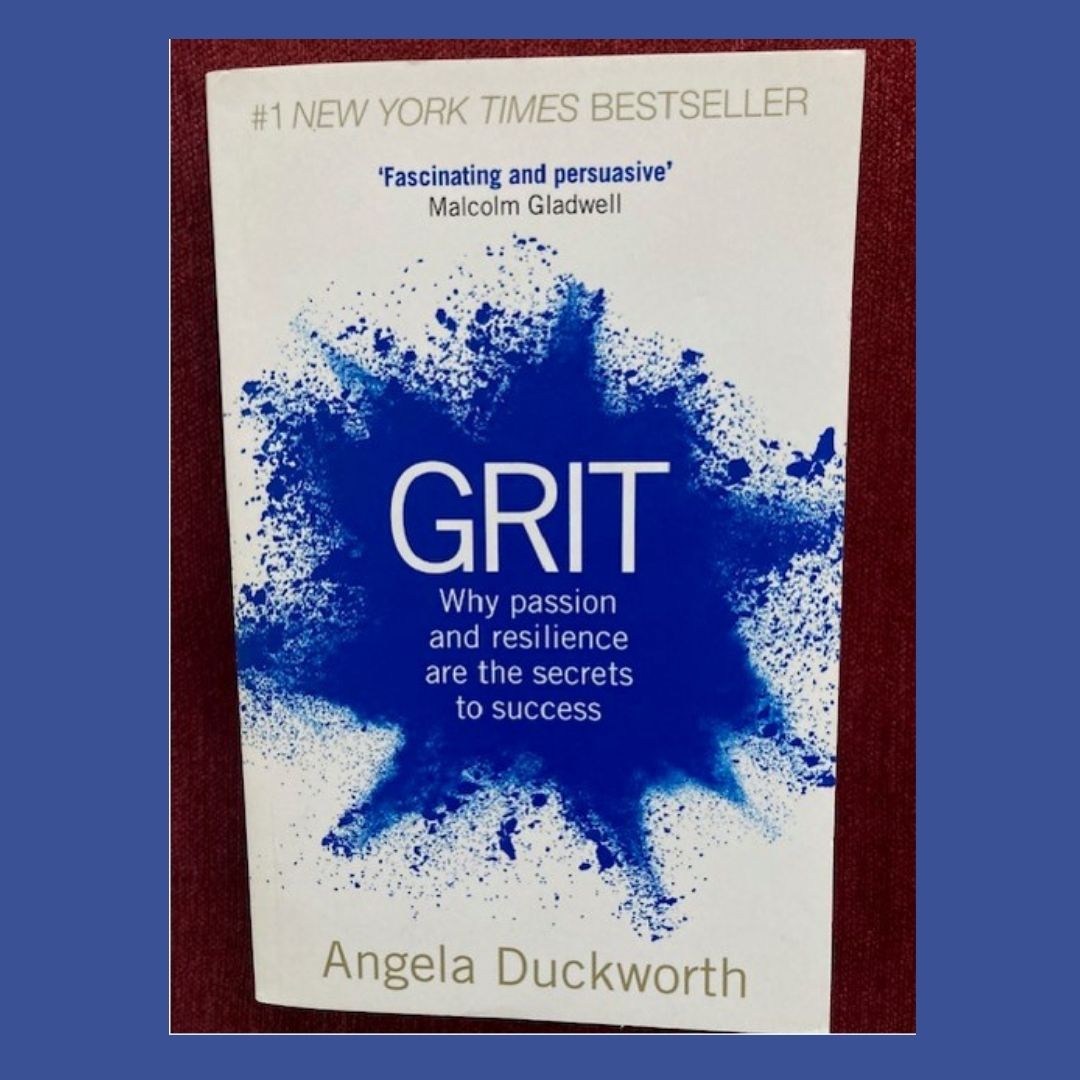
Grit

Angela Duckworth, author of “Grit” provides evidence that grit is a key component of many successes, with examples provided from the worlds of business, sport and education among others.

Grit is a combination of passion, perseverance and determination.

This book is full of examples and scientific evidence. Carol Dweck, author of “Mindset” is referenced and there is overlap in the messages both books convey.

Having a talent for something is not enough to become successful. Many of the stories told in the book demonstrate that success is attained by repeated practice. In line with Carol Dweck’s argument, we need to believe that we can become better by trying again. We must not give up when we encounter setbacks. In the long run, repeated effort will yield more reward than initial talent.

Specifically, Angela outlines 4 steps to grow our “grit from the inside out”.
1.      Interest –Whilst passion isn’t enough by itself, it is a necessary element.  Research shows that those with the highest levels of job satisfaction tend to work in roles which align with their interests. However, Angela goes on to explain that passion needs to be nurtured and is unlikely to strike us like a lightning bolt. Finding our interests should be an enjoyable process of discovery that can take time. Also, our interests and passions can change and we shouldn’t get hung up on finding our “one true calling”. She suggests thinking about the following questions to help identify our passion:
“What do I like to think about?  Where does my mind wander? What do I really care about? What matters most to me? How do I enjoy spending my time?”
Or she suggests, it might be easier to start by thinking about “What do I find unbearable?”

2.      Practice – we need to be willing to practice. The most effective practice entails a goal that stretches us, we need to give our full effort and we need feedback on our effort. After that, we reflect, refine and practice again.

3.      Purpose – we need to pursue something that matters in the world. In this section, Angela provides some interesting examples of how people doing the same role might see it differently with some thinking they have a job, others see themselves in a career and others feel they have a calling to do what they do.

4.      Hope – this is essential to help us recover from setbacks. Angela offers 3 tips to teach ourselves to have hope. She advises us to:
– Change limiting beliefs we might have about ourselves. 
– Be more positive in how we talk about and to ourselves.
– Ask others for help.

Other parts of the book offer the chance to take Angela’s Grit questionnaire to check how “gritty” we are already. Also Angela offers advice on how to grow your grit from the outside in and as part of this offers insight into how a mentor or parent might support grittiness in children.

This book was not a fast read for me but it was worth the time investment. I recommend it to you.

Road Trip

Recently, I was reminded of a Japanese backpacker, called Muzz whom I met in New Zealand 20 years ago.  We were all working on the same farm, which was in a remote location near Ohura, Taranaki in the North Island. 

Muzz had decided to move on to New Plymouth, which was over 100km from where we were. 

Our farmer hosts estimated it would be close to a 2.5 hour car drive and there was no direct bus routes.  They advised Muzz that hitchhiking, which was very common in NZ at the time, would be the best way to get to New Plymouth. Muzz wasn’t familiar with hitchhiking at all as it was not usual in Japan, but he was prepared to try it. 

Our hosts were making a delivery to Hamilton the following day so they brought Muzz as far as the main road and told him to stick his thumb out when any vehicles going south passed by. 

The trip to Hamilton was a journey north but was also going to be about 2.5 hours each way, so it was evening time when our hosts returned. 

They arrived bringing a Japanese backpacker with them… Muzz ! 

Muzz had stood by the side of the road all day. Six drivers stopped but none were going all the way to New Plymouth, so Muzz declined their offers of lifts.  

At the time, I felt sorry for Muzz because he was hungry and tired and back at square one.  

However, looking back I see that Muzz will have gained great learning that day.  

1. You need to know your destination. If you don’t, you’re just going to go where others bring you. One day you’ll realise you’re living someone else’s idea for your life rather than the version of life you choose for yourself. 

2. When you know your destination (like Muzz did), you need to be prepared that progress may only happen in stages. Standing still waiting for an easy ride all the way to the finish line could mean you don’t go anywhere. 

3. Be prepared to forgive yourself and get back on the road if you make a mistake or something doesn’t work out immediately. After his unproductive and tiring day, Muzz got up the following morning and went hitchhiking again. He travelled with 3 different drivers but reached his destination in just over 4 hours! 

Feature Image Credit: Martin Kallur via Unsplash

Zoom In/Zoom Out

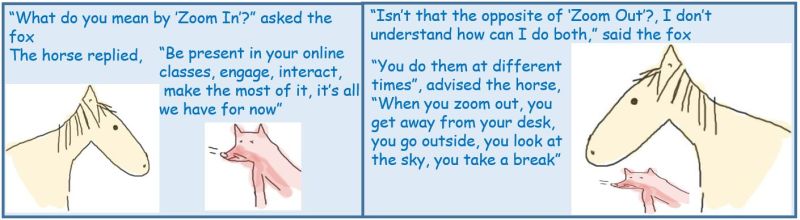
I really wanted to write something insightful to motivate us for Semester 2. I came up with what I thought was a great title, “Zoom In / Zoom Out”. However, the blog I attempted to write did not convey the message I wanted to share.
Instead, I attach a cartoon that I created. It’s inspired by Charlie Mackesy who is the author of a book called “The Boy, The Mole, The Fox and The Horse”. This is a wonderful book with a theme of resilience, gentleness and kindness, just right for the times in which we find ourselves.

Charlie Mackesy

Feature Image Credit: Jason Leung via Unsplash

What’s Your Definition of a Challenge at Work?

Well imagine you have to adapt to working remotely. Actually, you probably don’t have to imagine that. It is challenging but not impossible, you are doing it already.

Imagine that you are working remotely but with a completely new team, people you have never met in person. That is a bit more challenging.

Now imagine you are working remotely with people you have never met before and you have all just joined a new organisation. No one has the inside track on how things are done or what is expected. This sounds very challenging.

But this is exactly what many first year college students have been doing since September.

As we near the end of the semester, college students are submitting their teamwork projects online and delivering group presentations via Zoom. These students are coping with social isolation and missing out many aspects of their college experience. They have risen to their work challenges, although it has not been easy.

These students are developing adaptability, resilience and creativity skills that will be assets for life.

Feature Image Credit: Christoph Deinet via Unsplash