Belief Building August 2024

Whilst in Dublin recently, I visited the portal to New York. It was unveiled in May 2024 and after some early hiccups which caused it to close, it has re-opened.  There are now 4 global locations hosting portals, Lithuania, Poland, New York and Dublin, with more to come.

I found it fascinating. I was there around 1pm Dublin time (9am in New York) and there was a small crowd of people watching our New York counterparts busying on their way to work (many just waved as they hurried past). Then a guy on a bicycle pulled up and started doing dance moves.  Within a few minutes, he had the Dublin crowd copying his moves and we were all laughing and dancing.

Aside from the wonderful novelty of being taught dance moves from New York, it made me think about the power of movement.

I hope you enjoy this month’s newsletter!
Sinead

We have seen lots of movement at the recent Olympics. I was in awe of speed, flexibility, strength and talent every time I turned on the TV coverage. And there’s more to come as the Paralympics has got underway this week.

An athlete that caught attention on social media was Australian Rachael Gunn. Rachael, known as b-girl RayGun when competing, represented Australia at the Olympics inaugural break-dancing competition.

Rachael, aged 36 works as a lecturer at Macquarie University, Sydney. She scored zero points in her heats in Paris and was ridiculed for her unique style of break-dancing.

However, Rachael, who earned a PhD in 2017 researching cultural and gender based aspects of break-dancing, rose above the criticism to urge people to be different, creative and represent themselves.


I read an article recently where the actress Miranda Hart shared that she chooses to dance to one of her favourite songs when she is in a bad mood and that usually cheers her up.

She also says that when she is highly stressed, she tries to walk and move as slowly as possible and generally if she can succeed with that, she can calm herself down.

To mention an Olympian again, diver Jake Passmore uses another type of movement to help him focus and manage stress. He taught himself to juggle as a type of meditation before his competitions.

The benefits of movement are far reaching!


“Don’t be afraid to be different. Go out there and represent yourself, you never know where that’s gonna take you.” Rachael Gunn, Olympian

“You’re not getting up every morning thinking, ‘Olympic gold medal — I have to go and win that and if I don’t train hard, I won’t.’ You’d kind of, I dunno, lose your mind if you were thinking that every day. Mostly, what motivates us is just that we enjoy actually training every day — or more often than not, anyway, certainly.” Paul O’Donovan, Olympian

“Life is like riding a bicycle, to keep your balance, you must keep moving.” Albert Einstein

Belief Building July 2024

Whilst the Irish summer has not brought the weather we have been hoping for just yet, we have been spoilt with high profile sporting events.

Wimbledon’s tennis, the Euro’s soccer, Tour de France cycle race, and the Open golf tournament in Scotland have just recently come to a close.  

In Cork, the county is wearing red and white proudly and although our hurlers didn’t get to bring the Liam McCarthy cup home, the Cork camogie team continue to carry our hopes.

There is lots more sport in store as the Olympics has just begun in Paris.

Sport brings tremendous enjoyment and passion but what all these athletes have in common is belief.

As Henry Ford said, “Whether you think you can, or you think you can’t – you’re right.” 

A sport I didn’t mention yet is table tennis, read on for its relevance…

Zhiying Zeng played table tennis at an elite level in China throughout her teenage years. A change in rules introducing a bi-coloured table tennis bat, caused her to quit when she was 20 in 1986, as the new requirement didn’t suit her style of play. 

She thought her dream of competing in the Olympics was over.

She moved to Chile to work as a coach in 1989; set up a furniture business, married, had a family and made Chile her new home.

During the Covid19 lockdown, Zhiying, (or Tania as she is known in Chile), found her way back to table tennis.  With restrictions lifted, she started competing again and more significantly winning almost all the tournaments she entered.

Within a short time, she had gained a place on Chile’s national team.  Zhiying turned 58 this month and will be one of the oldest competitors at the Paris Olympics where she will represent Chile playing table tennis!


Remaining with the topic of table tennis, I want to mention the book “You Are Awesome” by Matthew Syed.  The book is aimed at children but in my opinion, everyone would benefit from reading it.

Matthew Syed, an accomplished author, represented Great Britain at the Olympics playing table tennis in 1992 and 2000.

His book, whilst based on how he became good at table tennis, is about mindset and belief.

He gives an easy to understand explanation of the concept of fixed versus growth mindset as expounded by Carol Dweck. 

A self described non-sporty person, Matthew adopted a growth mindset by believing he could improve his table tennis.

“A growth mindset is the belief that your ability is not fixed. You are not handed out a fixed pot of brilliance at birth. Instead you can grow and change your ability with practice, determination and effort.”

Matthew, now primarily an author rather than a table tennis player, goes on to explain how he breaks down his goals into separate elements and examines how he can make marginal gains in each area.  

It’s a useful book for anyone looking to inspire a friend or family member or offer self-encouragement, if in pursuit of a challenging goal.


“Some people say I have attitude – maybe I do… but I think you have to. You have to believe in yourself when no one else does – that makes you a winner right there.” Venus Williams

If we drop out when we hit problems, progress is scuppered, no matter how talented we are. If we interpret difficulties as indictments of who we are, rather than as pathways to progress, we will run a mile from failure. Grit, then, is strongly related to the Growth Mindset; it is about the way we conceptualise success and failure.” Matthew Syed

“I am the greatest. I said that before I even knew I was.” Muhammad Ali

Good Enough

For 4 weeks, I have been back on campus delivering lectures and interacting with students in person.

One student I was speaking to told me he had a phobia of maths. It was a major obstacle for him in studying economics.  Whilst he enjoyed the theory aspects, he feared he wouldn’t be good enough to pass the course given the maths content.

To his credit, he told me he was seeking extra help and had allocated daily time to focus on the maths elements.

I spoke to another student 3 weeks ago about presenting a project in front of the class. She told me that she hadn’t done any in person presentations in 2 years.  She felt very nervous and wondered if she could create a recording instead. She didn’t believe she would be good enough if presenting live. 

I spoke to her again this week and she told me that she was trying to practice at home and intended recruiting some friends to be a warm audience whilst she built up her confidence.

It felt rewarding to be encouraging these students and I firmly believe the actions they are taking; being proactive and practicing, will result in improvement for them.

Yesterday, after work, I was talking to my sister and she remarked that I hadn’t posted many blogs lately.

I agreed. I told her I was busy and didn’t have enough time to produce anything that would be good enough to post.

When I heard my own words, I realised I needed to take inspiration from my students.

Taking action and practicing helps us all improve!

Feature Image Credit: Estúdio Bloom via Unsplash.com

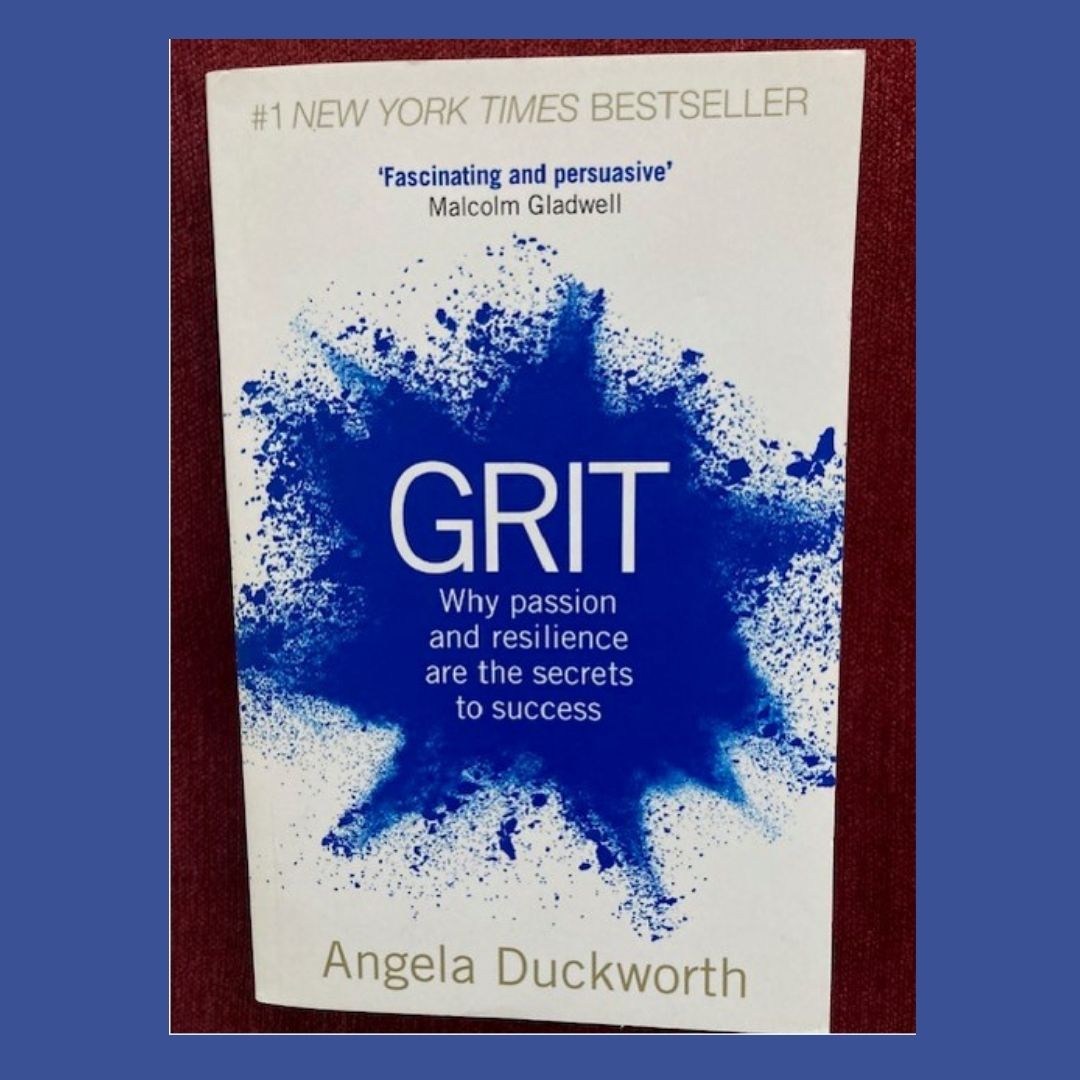
Grit

Angela Duckworth, author of “Grit” provides evidence that grit is a key component of many successes, with examples provided from the worlds of business, sport and education among others.

Grit is a combination of passion, perseverance and determination.

This book is full of examples and scientific evidence. Carol Dweck, author of “Mindset” is referenced and there is overlap in the messages both books convey.

Having a talent for something is not enough to become successful. Many of the stories told in the book demonstrate that success is attained by repeated practice. In line with Carol Dweck’s argument, we need to believe that we can become better by trying again. We must not give up when we encounter setbacks. In the long run, repeated effort will yield more reward than initial talent.

Specifically, Angela outlines 4 steps to grow our “grit from the inside out”.
1.      Interest –Whilst passion isn’t enough by itself, it is a necessary element.  Research shows that those with the highest levels of job satisfaction tend to work in roles which align with their interests. However, Angela goes on to explain that passion needs to be nurtured and is unlikely to strike us like a lightning bolt. Finding our interests should be an enjoyable process of discovery that can take time. Also, our interests and passions can change and we shouldn’t get hung up on finding our “one true calling”. She suggests thinking about the following questions to help identify our passion:
“What do I like to think about?  Where does my mind wander? What do I really care about? What matters most to me? How do I enjoy spending my time?”
Or she suggests, it might be easier to start by thinking about “What do I find unbearable?”

2.      Practice – we need to be willing to practice. The most effective practice entails a goal that stretches us, we need to give our full effort and we need feedback on our effort. After that, we reflect, refine and practice again.

3.      Purpose – we need to pursue something that matters in the world. In this section, Angela provides some interesting examples of how people doing the same role might see it differently with some thinking they have a job, others see themselves in a career and others feel they have a calling to do what they do.

4.      Hope – this is essential to help us recover from setbacks. Angela offers 3 tips to teach ourselves to have hope. She advises us to:
– Change limiting beliefs we might have about ourselves. 
– Be more positive in how we talk about and to ourselves.
– Ask others for help.

Other parts of the book offer the chance to take Angela’s Grit questionnaire to check how “gritty” we are already. Also Angela offers advice on how to grow your grit from the outside in and as part of this offers insight into how a mentor or parent might support grittiness in children.

This book was not a fast read for me but it was worth the time investment. I recommend it to you.

Time

I like this time of year. I like the changing colours on the trees. I like wearing warm, cosy clothes. And I really like gaining an extra hour when the clocks change!

Almost everyone I know is pressed for time, always rushing and often running late. Getting an extra hour is a gift!

Previously, I have been quite a time obsessed type of person, feeling stressed when I encounter a delay. 

Recently, I added a reminder to my phone that pops up twice a day.  It says: “I have all the time I need for everything”. It’s an affirmation that is helping me to have perspective about time and deadlines.

In addition, I’m trying out some other strategies to help with having more time.

1.      Before I go to bed in the evening, I make decisions for the next day, choices like what clothes I’ll wear.  Doing this the night before means I’m quite purposeful as I am looking forward to going to sleep, and I don’t delay. This then leads to a more streamlined morning, as I get straight into my day’s priorities.

2.      I have started to reduce the time I spend making minor decisions. For example, when someone mentions a good film or TV show, I put a note in my phone, and follow that recommendation as opposed to losing time weighing up different options.  Various studies have shown that people spend an average of 20 minutes or more choosing what to watch on TV.

3.      I am trying to set time limits for unimportant tasks like scrolling through social media. An academic I know allows herself 10 minutes of scrolling through Twitter after 50 minutes of concentrated work. In his book, “Atomic Habits”, James Clear shares that he gets his assistant to change his social media passwords on Monday morning so he can’t access his accounts until he gets the new passwords sent to him at the weekend. I haven’t gone quite that far but it’s an idea worth considering.

What would you add to the list?

Feature Image credit: Malvestida Magazine via Unsplash

High 5

Mel Robbins, now a best selling author, entrepreneur and coach, was once someone who struggled to get out of bed in the morning. She kept pressing snooze on the alarm clock to avoid being confronted by her daily struggles and unhappy life.

One afternoon she was inspired by a TV advertisement, which showed a rocket blasting off after a 5 second countdown.

This motivated her and the next day she replaced pressing snooze on the alarm clock with counting down in her head “5,4,3,2,1, blast-off” and got out of bed. This marked the beginning of a new approach for Mel.

She started using the 5 second rule and turned her life around. When she had a good idea or impulse, rather than talk herself out of it, she undertook an action within 5 seconds.

Although it seems very simplistic, the approach has a scientific basis. The strategy wards off procrastination and diverts our brains away from over-thinking and self doubt, thus leading to action and greater productivity. 

I read Mel’s book “The 5 Second Rule” a few years ago and still sometimes use the countdown in my head, especially when I need to do things I don’t feel like doing.

This year, Mel has brought out a new book “The High 5 Habit”. Its premise also seems very simple. Mel encourages us to give ourselves a high 5 in the mirror every morning. 

We support ourselves in this action, as opposed to being reliant on external validation. The research says that by taking a moment to reflect on and celebrate being ourselves, we increase motivation and productivity.

I haven’t read the book yet but I am going to add a self high 5 to my day, it’s a simple habit to incorporate especially if it increases motivation and performance and I don’t think Mel would want me to procrastinate!

Feature Image Credit: Bill Jelen via Unsplash

Road Trip

Recently, I was reminded of a Japanese backpacker, called Muzz whom I met in New Zealand 20 years ago.  We were all working on the same farm, which was in a remote location near Ohura, Taranaki in the North Island. 

Muzz had decided to move on to New Plymouth, which was over 100km from where we were. 

Our farmer hosts estimated it would be close to a 2.5 hour car drive and there was no direct bus routes.  They advised Muzz that hitchhiking, which was very common in NZ at the time, would be the best way to get to New Plymouth. Muzz wasn’t familiar with hitchhiking at all as it was not usual in Japan, but he was prepared to try it. 

Our hosts were making a delivery to Hamilton the following day so they brought Muzz as far as the main road and told him to stick his thumb out when any vehicles going south passed by. 

The trip to Hamilton was a journey north but was also going to be about 2.5 hours each way, so it was evening time when our hosts returned. 

They arrived bringing a Japanese backpacker with them… Muzz ! 

Muzz had stood by the side of the road all day. Six drivers stopped but none were going all the way to New Plymouth, so Muzz declined their offers of lifts.  

At the time, I felt sorry for Muzz because he was hungry and tired and back at square one.  

However, looking back I see that Muzz will have gained great learning that day.  

1. You need to know your destination. If you don’t, you’re just going to go where others bring you. One day you’ll realise you’re living someone else’s idea for your life rather than the version of life you choose for yourself. 

2. When you know your destination (like Muzz did), you need to be prepared that progress may only happen in stages. Standing still waiting for an easy ride all the way to the finish line could mean you don’t go anywhere. 

3. Be prepared to forgive yourself and get back on the road if you make a mistake or something doesn’t work out immediately. After his unproductive and tiring day, Muzz got up the following morning and went hitchhiking again. He travelled with 3 different drivers but reached his destination in just over 4 hours! 

Feature Image Credit: Martin Kallur via Unsplash