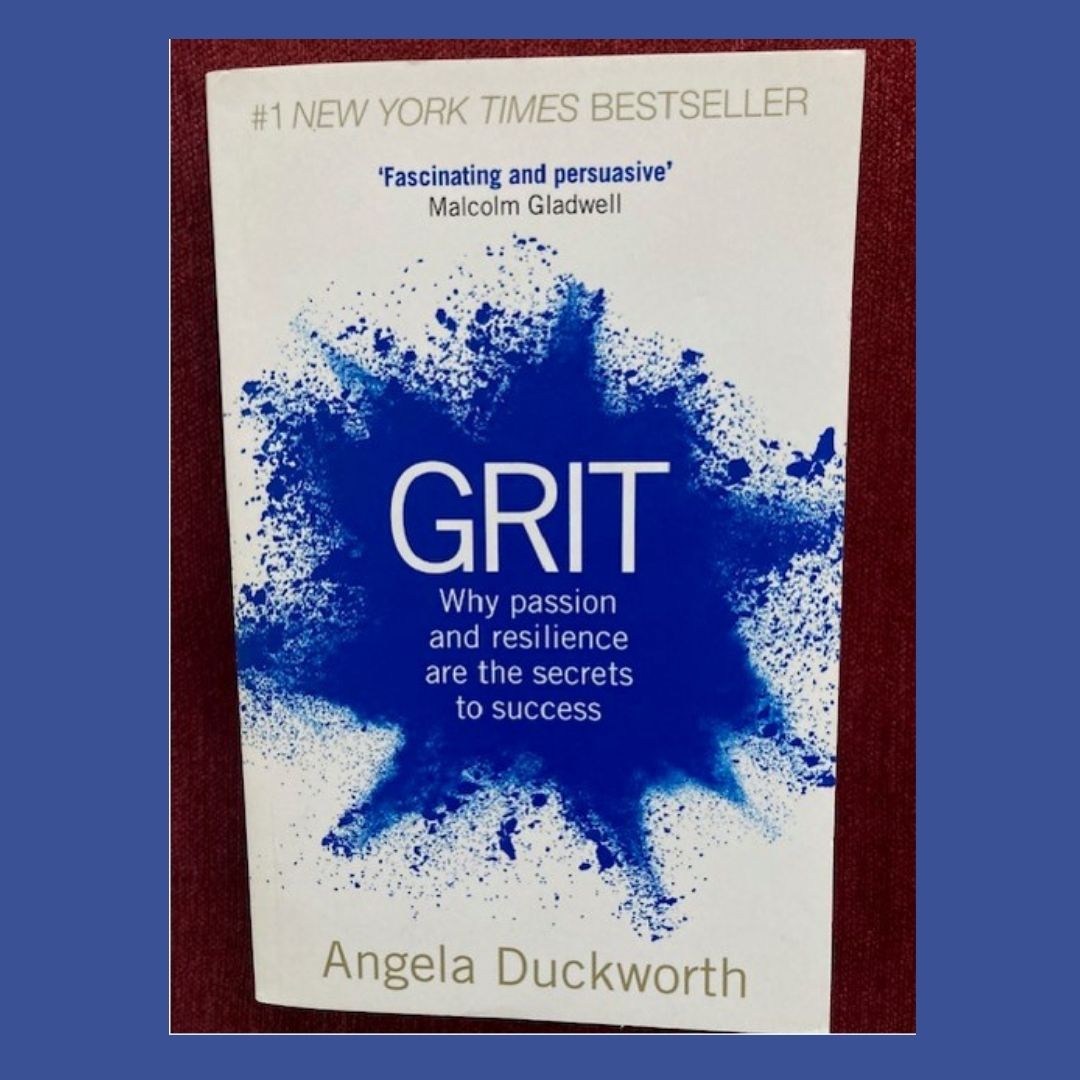
Grit

Angela Duckworth, author of “Grit” provides evidence that grit is a key component of many successes, with examples provided from the worlds of business, sport and education among others.

Grit is a combination of passion, perseverance and determination.

This book is full of examples and scientific evidence. Carol Dweck, author of “Mindset” is referenced and there is overlap in the messages both books convey.

Having a talent for something is not enough to become successful. Many of the stories told in the book demonstrate that success is attained by repeated practice. In line with Carol Dweck’s argument, we need to believe that we can become better by trying again. We must not give up when we encounter setbacks. In the long run, repeated effort will yield more reward than initial talent.

Specifically, Angela outlines 4 steps to grow our “grit from the inside out”.
1.      Interest –Whilst passion isn’t enough by itself, it is a necessary element.  Research shows that those with the highest levels of job satisfaction tend to work in roles which align with their interests. However, Angela goes on to explain that passion needs to be nurtured and is unlikely to strike us like a lightning bolt. Finding our interests should be an enjoyable process of discovery that can take time. Also, our interests and passions can change and we shouldn’t get hung up on finding our “one true calling”. She suggests thinking about the following questions to help identify our passion:
“What do I like to think about?  Where does my mind wander? What do I really care about? What matters most to me? How do I enjoy spending my time?”
Or she suggests, it might be easier to start by thinking about “What do I find unbearable?”

2.      Practice – we need to be willing to practice. The most effective practice entails a goal that stretches us, we need to give our full effort and we need feedback on our effort. After that, we reflect, refine and practice again.

3.      Purpose – we need to pursue something that matters in the world. In this section, Angela provides some interesting examples of how people doing the same role might see it differently with some thinking they have a job, others see themselves in a career and others feel they have a calling to do what they do.

4.      Hope – this is essential to help us recover from setbacks. Angela offers 3 tips to teach ourselves to have hope. She advises us to:
– Change limiting beliefs we might have about ourselves. 
– Be more positive in how we talk about and to ourselves.
– Ask others for help.

Other parts of the book offer the chance to take Angela’s Grit questionnaire to check how “gritty” we are already. Also Angela offers advice on how to grow your grit from the outside in and as part of this offers insight into how a mentor or parent might support grittiness in children.

This book was not a fast read for me but it was worth the time investment. I recommend it to you.

High 5

Mel Robbins, now a best selling author, entrepreneur and coach, was once someone who struggled to get out of bed in the morning. She kept pressing snooze on the alarm clock to avoid being confronted by her daily struggles and unhappy life.

One afternoon she was inspired by a TV advertisement, which showed a rocket blasting off after a 5 second countdown.

This motivated her and the next day she replaced pressing snooze on the alarm clock with counting down in her head “5,4,3,2,1, blast-off” and got out of bed. This marked the beginning of a new approach for Mel.

She started using the 5 second rule and turned her life around. When she had a good idea or impulse, rather than talk herself out of it, she undertook an action within 5 seconds.

Although it seems very simplistic, the approach has a scientific basis. The strategy wards off procrastination and diverts our brains away from over-thinking and self doubt, thus leading to action and greater productivity. 

I read Mel’s book “The 5 Second Rule” a few years ago and still sometimes use the countdown in my head, especially when I need to do things I don’t feel like doing.

This year, Mel has brought out a new book “The High 5 Habit”. Its premise also seems very simple. Mel encourages us to give ourselves a high 5 in the mirror every morning. 

We support ourselves in this action, as opposed to being reliant on external validation. The research says that by taking a moment to reflect on and celebrate being ourselves, we increase motivation and productivity.

I haven’t read the book yet but I am going to add a self high 5 to my day, it’s a simple habit to incorporate especially if it increases motivation and performance and I don’t think Mel would want me to procrastinate!

Feature Image Credit: Bill Jelen via Unsplash

Diverse Teams

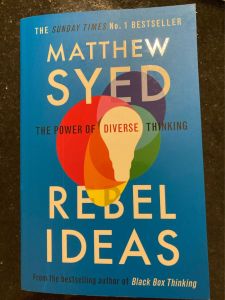
I have been reading “Rebel Ideas” by Matthew Syed. I agree with the main theme of the book – diverse teams are likely to be more successful as there is the benefit of different ideas, insights and perspectives.

I like this photo of stones on a beach.  All the parts are different shapes, sizes and colours but put together, we can see a white seam that runs through them to make a circle.

I think this can be a good way to think about teams. The participants can be very different, yet by working together they produce valuable, beneficial, creative output.

Rebel Ideas

Given the importance of this week for Cork Hurling, I thought writing about a book with REBEL in the title would be appropriate.

However, unlike the level of preparation that I’m sure will be evident at this weekend‘s matches and was in full display at Wednesday’s U20 final, I actually haven’t finished reading the book “Rebel Ideas” by Matthew Syed yet!

From what I’ve read so far, I see the argument that diverse perspectives lead to greater success in solving problems.

Key factors can be missed if the investigation team comprises of people who all have similar upbringings, experience and education. The author analyses a number of well known events to support this point.

At this stage, my takeaway from the partly read book is that the best teams have a variety of participants with different backgrounds who bring a range of distinct skills and strategies. The book is interesting and easy to read, so I will finish it.

I have read another of Matthew Syed’s books “You are Awesome” in its entirety and can recommend it as easy to read and a source of inspiration for both adults and children.

“Best teams”… “skills and strategies”… “awesome”…reminds me of Cork Hurling!

Feature Image via Canva

The Artist’s Way

Creative block?

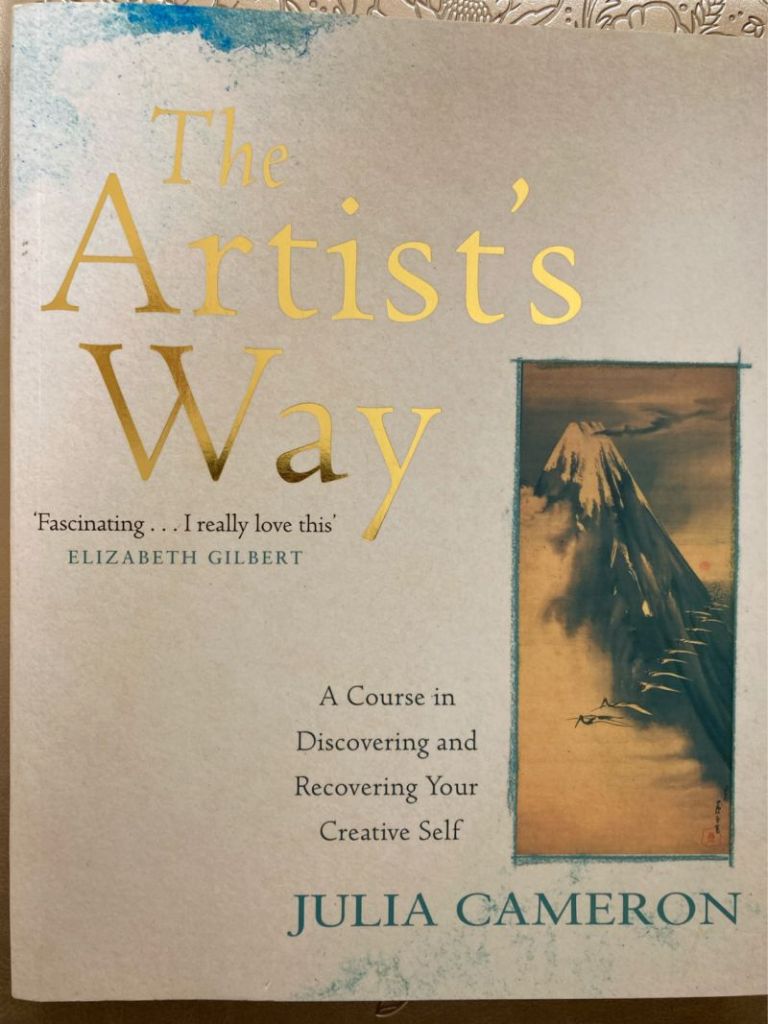
Recently I read “The Artist’s Way” by Julia Cameron (twice!) and enjoyed it (twice!).

Artist does not necessarily mean Painter, it represents anyone in pursuit of creativity, regardless of career.

Rather than being set out in chapters, the book is organised as a 12 week course.

The objective of the course is to help us rediscover our creativity. Each week focuses on a particular theme and offers practical suggestions to help us recover and discover the creative flair we might have practiced unselfconsciously as children.

In addition to the weekly exercises, 2 basic tools are recommended, “morning pages” and “the artist date”.

Writing three A4 pages everyday is a conversation with ourselves- perhaps covering thoughts we wouldn’t dare reveal to anyone else. It’s a chance to pour out hopes, dreams, fears and frustrations privately.

The Artist date, is a weekly time investment doing something by ourselves for ourselves; being in nature, listening to music or trying a new food. The date can be anything but should feel like play and not work. This is to replenish our creative resources.

If you have temporarily forgotten how to practice and enjoy your creativity, or feel an artistic block, this book is definitely worth reading!

Feature Image Credit: Seema Miah via Unsplash

The 7 Habits of Highly Effective People

The physical and mental strength displayed at the Olympics reminded me of Stephen Covey’s book “The 7 Habits of Highly Effective People”.

The habits are broken down into the first 3 which relate to self management and development.

Habits 4 to 6 offer advice on how best to approach our interactions with others.

Habit 7 is “sharpen the saw” which is about self care.

We wouldn’t try to cut down a tree with a blunt, worn out saw and this analogy is used to advise us to be proactive in looking after ourselves. The Olympic athletes are prime examples of this habit.

By investing in sleep, nutrition and activity we can keep ourselves in peak physical condition.

We can take care of our spiritual lives by meditating or spending time in nature.

We choose to maintain mental fitness by being conscious of what we consume in terms of media and reading.

For optimum social interaction, Covey recommends we have authentic, meaningful connections whilst being helpful to others. It was heartening to see the recent support for all athletes, regardless of their level of success.

My copy of the book is quite old but I was pleasantly surprised with how easy to read it is and how relevant it remains in 2021.

If I liked this book, what others should I try?

Feature Image via Canva

Bad Habits

Listening to Ed Sheeran’s new song reminded me of James Clear’s book “Atomic Habits”.

James offers advice to help with fostering desired habits. He describes a method of stacking habits so that certain behaviours follow others without us even having to think about it.

The song “Bad Habits” provides a good example of how this works too, although in this case the stacking is for behaviours described as bad habits.

In my interpretation of the lyrics, going out late brings the character in the song to pubs/clubs where autopilot associations lead him to vices that he knows are bad for him.

The book offers advice on how adopting tiny behaviour changes can lead to greater success and break bad habits.

So cool bat-like character in Ed Sheeran’s new video, if you’re reading this, I recommend you stop and instead invest your time in reading James Clear’s book.

James Clear, if you’re reading this, I recommend you check out the song, it’s lyrics, tune and video are all great.

And Ed Sheeran, if you’re reading this, I think it’s genius that your song implies its unlikely that we’ll break our habits but yet in creating this song you’ve deviated from your usual style and so you’ve inspired us that it is possible to change our patterns.

Feature Image Credit: Manan Chhabra via Unsplash

Zoom In/Zoom Out

I really wanted to write something insightful to motivate us for Semester 2. I came up with what I thought was a great title, “Zoom In / Zoom Out”. However, the blog I attempted to write did not convey the message I wanted to share.
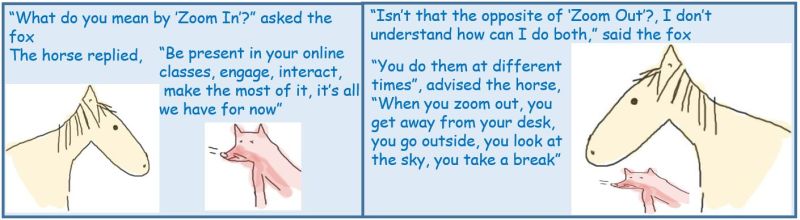
Instead, I attach a cartoon that I created. It’s inspired by Charlie Mackesy who is the author of a book called “The Boy, The Mole, The Fox and The Horse”. This is a wonderful book with a theme of resilience, gentleness and kindness, just right for the times in which we find ourselves.

Charlie Mackesy

Feature Image Credit: Jason Leung via Unsplash